
Market Data · Ocala & Marion County, Florida
Why Ocala? The Data Behind America's Fastest-Growing Metro
For two consecutive years, the U.S. Census Bureau ranked the Ocala metro the fastest-growing in the United States. Here is what the numbers actually say — population, migration, industrial expansion, jobs — and what it means for Central Florida commercial real estate.
Last updated May 2026 · SVN McDonald & Company Research
How fast is Ocala growing?
The Ocala metropolitan area — which is coterminous with Marion County — reached an estimated 442,660 residents as of July 1, 2025, according to the U.S. Census Bureau. That is an increase of more than 66,700 people since the 2020 Census, or roughly 17.8% in five years. The Census Bureau named Ocala the #1 fastest-growing metro in the United States by percentage growth in both its 2023–2024 and 2024–2025 population estimates — the second year in a row at the top of the national list.
| Period | Population | Annual change |
|---|---|---|
| 2020 (decennial Census) | 375,908 | baseline |
| July 2024 (estimate) | 428,000 | +4.0% YoY (2023–24) |
| July 2025 (estimate) | 442,660 | +3.4% YoY (2024–25) |
Source: U.S. Census Bureau Vintage 2025 population estimates. 2024 figure approximate. Ocala MSA = Marion County, FL.
Why are people moving to Ocala?
In 2023–2024, an estimated 318 people per week — about 45 per day — moved into the Ocala market. U-Haul named Ocala its #1 U.S. growth city for in-migration in 2024, the third time in four years it has topped that index, with 53.7% of one-way truck traffic inbound. The recurring reasons:
- ›Lower cost of living and land prices than Orlando, Tampa, and South Florida
- ›Interstate 75 access — within a few hours of most of Florida’s population
- ›Rapid job growth in manufacturing, distribution, and healthcare
- ›Retirement and lifestyle migration, including 55+ communities
- ›Remote workers relocating from higher-cost states
- ›The World Equestrian Center drawing visitors, residents, and investment
The industrial & logistics boom
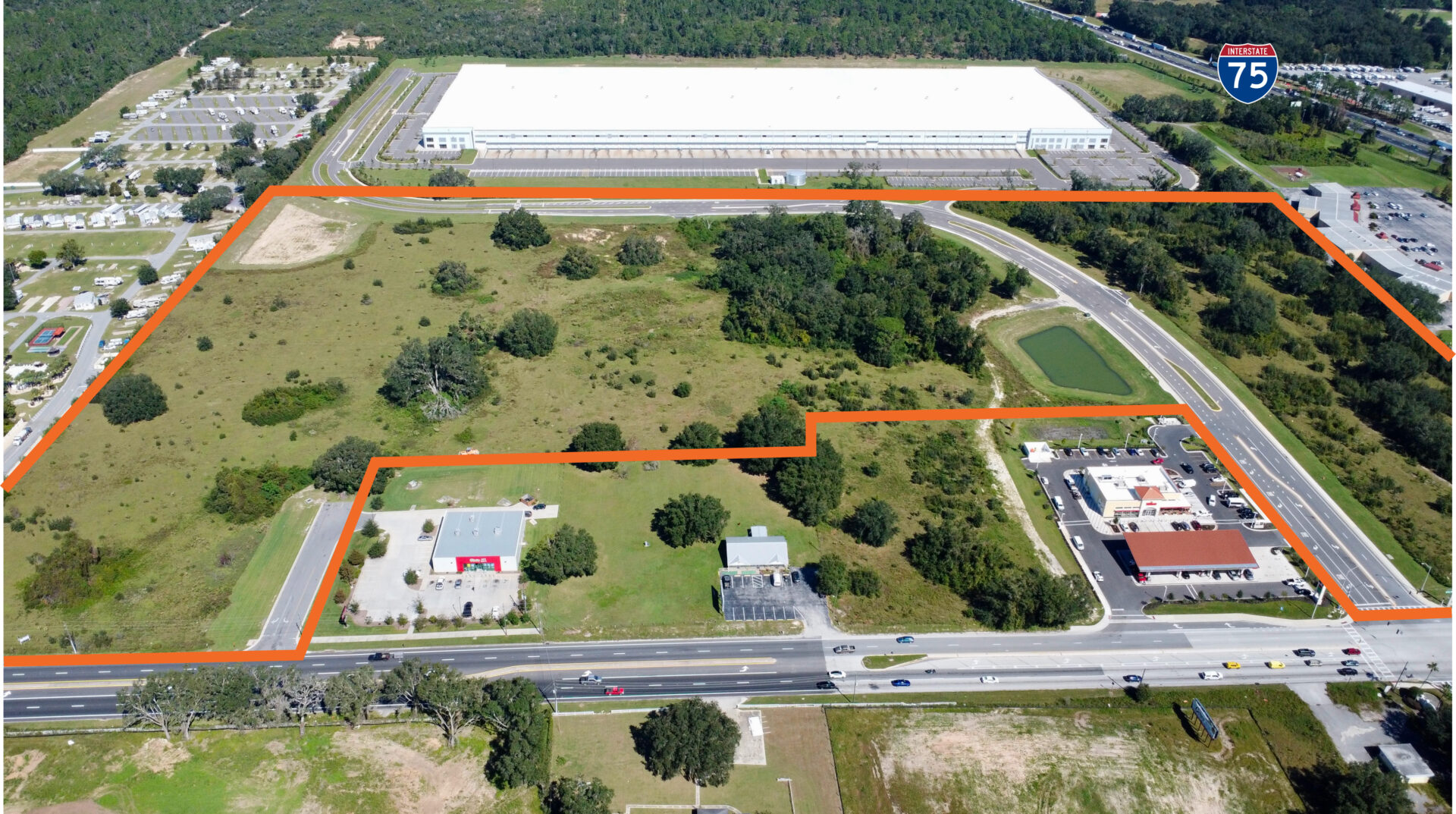
Ocala has transformed from a market known for equestrian, retirement, and healthcare into one of the Southeast's fastest-growing secondary logistics hubs. The Ocala/Marion County Commerce Park and Florida Crossroads Logistics Center along I-75 now anchor a roughly 500-acre cluster of national distributors:
Amazon
1,085,280 SF warehouse acquired for ~$97.7M (2025) + a 617,000 SF building, plus its original fulfillment center
Chewy
Major e-commerce distribution center in the I-75 commerce park
FedEx
Regional distribution / logistics operation
AutoZone
Distribution center within the ~500-acre commerce park
Dollar Tree
Large-format distribution presence
Owens Corning
Manufacturing operation anchoring the industrial base
That absorption has driven up trucking demand, warehouse occupancy, and industrial land values across the corridor. See current Ocala industrial & warehouse listings for active opportunities.
Housing & construction
To keep pace with in-migration, Marion County authorized nearly 6,730 new housing units by building permit in 2024 (Federal Reserve / Census data). Master-planned communities and single-family rooftops are concentrated in a handful of high-growth submarkets:
Jobs & the economy
Forbes has named the Ocala MSA to its Top 10 metros for future job growth for multiple consecutive years, with projected job growth more than double the national average. Hiring is strongest in transportation and warehousing, manufacturing, healthcare, construction, and professional services — and the share of the local labor force in manufacturing runs roughly twice the Florida state average. Continued in-migration keeps feeding the workforce that employers need.
Ocala's national rankings at a glance
| Category | National standing | Source |
|---|---|---|
| Population growth (% change) | #1 U.S. metro — 2023–24 and 2024–25 | U.S. Census Bureau |
| In-migration (U-Haul Growth Index) | #1 U.S. growth city — 2024 (3rd time in 4 years) | U-Haul |
| Future job growth | Forbes Top 10 metro, multiple consecutive years | Forbes |
| Net new residents added | 48th nationally — from the 146th-largest metro | U.S. Census Bureau |
| Manufacturing workforce share | ≈2× the Florida state average | Ocala CEP / BLS |
Why national investors are watching Ocala
Institutional capital increasingly views Ocala the way it viewed Lakeland 10–15 years ago or Jacksonville's industrial market a generation ago: an emerging secondary market with cheaper land, favorable taxes, available workforce, central-Florida access, and explosive population growth — at lower barriers to entry than Orlando or Tampa. The result is institutional warehouse development, IOS (industrial outdoor storage) interest, large master-planned projects, medical-office growth, and retail following the rooftops. For a deeper look at how one catalyst is reshaping land values, read our World Equestrian Center land report.
Ocala growth: frequently asked questions
Is Ocala, Florida really the fastest-growing metro in the U.S.?
Yes. The U.S. Census Bureau ranked the Ocala metro area (Marion County) the #1 fastest-growing metropolitan area in the United States by percentage population growth for two consecutive years — in both its 2023–2024 and 2024–2025 population estimates. As of July 1, 2025, the Ocala metro had an estimated population of 442,660, up roughly 3.4% in a single year.
How fast is Ocala / Marion County growing each year?
The Ocala metro grew about 3.4% between July 2024 and July 2025, adding more than 14,600 residents in one year. Since the 2020 Census, the metro has gained more than 66,700 people — an increase of roughly 17.8%. During the 2023–2024 period that translated to about 318 new residents per week, or roughly 45 people moving to the area every day.
Why are so many people and businesses moving to Ocala?
The main drivers are affordability and location. Ocala's cost of living and land prices are lower than nearby Orlando, Tampa, and South Florida, while its position on the Interstate 75 corridor puts it within a few hours of most of Florida's population. Strong job creation in manufacturing, distribution, healthcare, and construction — plus lifestyle and retirement migration and the World Equestrian Center — round out the demand. U-Haul named Ocala its #1 U.S. growth city for in-migration in 2024.
What major companies have distribution centers in Ocala?
The Ocala/Marion County Commerce Park and Florida Crossroads Logistics Center along I-75 host major logistics and manufacturing users including Amazon, Chewy, FedEx, AutoZone, Dollar Tree, and Owens Corning. Amazon alone operates multiple facilities in the area, including a 1,085,280-square-foot warehouse it acquired for about $97.7 million in 2025 and a 617,000-square-foot building, in addition to its original fulfillment center.
Why are commercial real estate investors interested in Ocala?
Investors are drawn to Ocala for the same reasons residents are: lower industrial land and labor costs, favorable taxes, available large sites, a growing workforce, central Florida access, and explosive population growth — with lower barriers to entry than Orlando or Tampa. Many institutional investors view Ocala today the way they viewed Lakeland 10–15 years ago or Jacksonville's industrial market a generation ago: an emerging secondary logistics and growth market.
Which areas of Ocala and Marion County are growing the fastest?
High-growth submarkets include Marion Oaks, southwest Ocala, the State Road 200 corridor, the World Equestrian Center corridor, Silver Springs Shores, and the Belleview/Summerfield area. These areas are seeing the bulk of new single-family rooftops, master-planned community expansion, and the retail and commercial development that follows residential growth.
Sources & methodology
Figures on this page are drawn from primary public data sources, current as of May 2026. The Ocala Metropolitan Statistical Area is coterminous with Marion County, Florida. We update this page as new estimates are released.
- U.S. Census Bureau — Metro & Micro Area Population Estimates (Vintage 2025)
- University of Florida, Bureau of Economic and Business Research (BEBR)
- U-Haul Growth Index — Top U.S. Growth Cities
- U.S. Bureau of Labor Statistics — Ocala, FL economic data
- Federal Reserve (FRED) — Marion County, FL building permits
- Ocala Metro CEP (Chamber & Economic Partnership)
Invest in the fastest-growing metro in America
SVN McDonald & Company is Ocala's commercial and land brokerage. If you want to buy, sell, or invest in the Marion County market, our research team can put this data to work for you.